
“A global politics of rescue”
By Siobhán McGrath and Fabiola Mieres
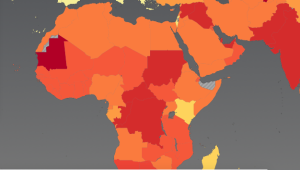
Screen shot from 2014 Global slavery Index (see http://www.globalslaveryindex.org/)
Africa is bleeding red.
We refer to the first image on the webpage of Walk Free’s Global Slavery Index (GSI) 2014: a map depicting the estimated prevalence of “modern slavery” in 167 countries. “Modern slavery” is understood by Walk Free to include trafficking, forced labour and forced marriage. At a glance, the map shows the Middle East and most of Asia in shades of red and orange, faring hardly better than the African continent. Lighter shades in Latin America seem to indicate progress in comparison. In turn, Western Europe, North America, Australia and New Zealand tend towards pale yellow. Such an image suggests the Global North metaphorically shedding light onto the dark parts of the world where slavery still flourishes. The image troubles us. It is replete with colonial overtones, ones which have been carried into the modern project of development. Thus, rather than providing an exhaustive critique of the methodology behind the GSI, in the rest of this brief commentary, we explore some of the politics of the report and of its methodology. Continue reading their commentary here
Readers might also be interested in Ben Rogaly’s Society and Space review of Judy Fudge and Kendra Strauss (Eds) Temporary work, agencies and unfree labour: insecurity in the new world of work
and Open Democracy’s Beyond Slavery https://www.opendemocracy.net/beyondslavery

Reblogged this on Progressive Geographies and commented:
A new commentary at the Society and Space open site.
Reblogged this on Déowyth.
Reblogged this on PHILOSOPHY IN A TIME OF ERROR and commented:
The first of two excellent pieces at Society and Space that I missed over the holiday weekend.