
Joseph Masco is Professor of Anthropology at the University of Chicago. He is the author of The Nuclear Borderlands: The Manhattan Project in Post-Cold War New Mexico, winner of the J. I. Staley Prize from the School for Advanced Research, the Rachel Carson Prize from the Society for the Social Studies of Science, and the Robert K. Merton Prize from the American Sociology Association. His current work examines the evolution of the national security state in the United States, with a particular focus on the interplay between affect, technology, and threat perception within a national public sphere.
Sonia Grant is a PhD student in the Department of Anthropology at the University of Chicago. Her work focuses on the environment and environmental regulations, and the rise of hydraulic fracturing (fracking) in the US, and her article “Securing tar sands circulation: risk, affect, and anticipating the Line 9 reversal” appears in Environment and Planning D: Society and Space 32(6). Sonia can be reached at soniagrant[at]uchicago.edu
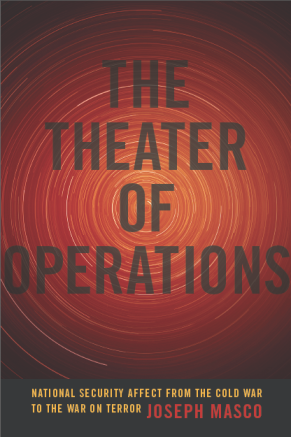 Sonia Grant: Thank you for taking the time to talk about your new book, The Theater of Operations: National Security Affect from the Cold War to the War on Terror (2014). I’d like to start by getting a sense of what brought you to this project, and what kinds of continuities you see between it and your first book, The Nuclear Borderlands: The Manhattan Project in Post-Cold War New Mexico (2006). Both books engage with Cold War national security culture, technoscience, and secrecy, among other key themes. How did The Theater of Operations, as a project, develop for you? Did it feel like an obvious ‘next step’ from your work on the Manhattan Project?
Joseph Masco: While I was concluding fieldwork on The Nuclear Borderlands, the September 2001 attacks occurred and provoked a massive U.S. military buildup while renewing national fears of a nuclear catastrophe. White House officials were quick to declare a “new normal” of counterterrorism, marked explicitly as a radical break from Cold War notions of security. This rejection of deterrence, combined with an amplification of existential threats, were central themes in what became a pretty shocking militarization of American society. The War on Terror – as a political project — was a systematic attempt to create amnesia about the 20th century security state (and its prior actions in Iraq and Afghanistan) while at the same time using the familiar Cold War notion of nuclear danger to foment an existential crisis, one enabling quite radical actions around the world.
Some of the first conversations I had in Los Alamos in the early 1990s concerned the future of the laboratory, and of the U.S. nuclear weapons program more broadly, in light of the demise of the Soviet Union. At that time, U.S. weapons scientists were already talking about nuclear terrorism, the threat of radical forms of Islam, and, above all, were positing the arrival of a violent global adversary that could not be deterred. So, in a sense, the counter-terror state project was articulated to me almost a decade before the 9/11 attacks.
Continue reading here.

Reblogged this on Progressive Geographies and commented:
Fascinating interview with Joseph Masco at the Society and Space open site.
Reblogged this on PHILOSOPHY IN A TIME OF ERROR.