
The following essay is a supplement to Withdrawing from atmosphere: An ontology of air partitioning and affective engineering, by Andreas Philippopoulos-Mihalopoulos. The article is from volume 34, issue 1 of Environment and Planning D: Society and Space and has been made free to access for the next month.
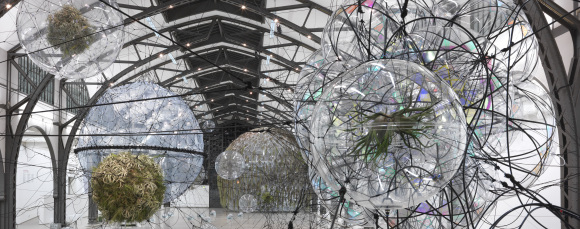
All images copyright Studio Tomas Saraceno
There has been a surge in the research on atmosphere as a phenomenological emergence (Borch, 2014). These atmospheres are mostly architectural (Zumthor, 2012) but also philosophical (Böhme, 1995), sociological (Sloterdijk, 2013), financial (McCormack, 2015), and socioenvironmental (Choy, 2011). Ever since Anderson’s 2009 article on “Affective Atmospheres,” atmospheres are understood as affective emergences, situated between the subject and the object, apprehended phenomenologically and, especially if appropriately constructed, contributing to human well being. Atmospherics, in other words, have managed to generate their own comfortable atmosphere around them.
I would like to warn against this atmospheric comfort and especially the proliferation of benign atmospheric constructions, smoothly establishing a measurability (of well-being, belonging, social cohesion, integration, and so on) that only serves the perpetuation of the very atmosphere. In the companion piece “Withdrawing from atmosphere: An ontology of air partitioning and affective engineering” published in Environment and Planning D: Society and Space 34(1): 150-167, I engage in a critique of atmospheres by, first, moving deeper into atmosphere and specifically its main element, that of air and how it is regularly conditioned and partitioned for the preservation of an atmosphere; second, by critiquing the standard phenomenological construction of atmosphere as complicit to the all-containing atmospheric comfort, and introducing instead an atmospheric ontology; and, third, by engaging with international artist Tomás Saraceno’s art practice in order to render the atmospheric ontology tangible and to indicate ways out of the atmosphere. In this text here, I would like to focus on the latter, by expanding on the subtle ways in which Saraceno’s atmospheric installations can shift from the claustrophobic to the exhilaratingly open.
Continue reading here.
