
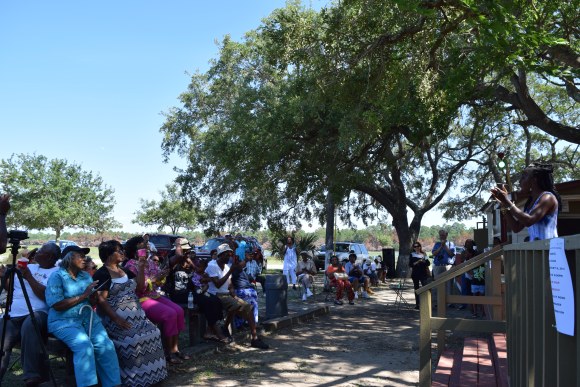
Queen Quet addresses a crowd at Mosquito Beach on James Island, South Carolina during a Gullah/Geechee Famlee Day event in July 2015. Mosquito Beach was a popular destination for Gullah/Geechees and other African Americans during Jim Crow and remains a site of significance in the Gullah/Geechee community.
This post accompanies “Situated solidarities and the practice of scholar-activism”, an article co-authored by Paul Routledge and me that appears in volume 33, issue 3 of Environment and Planning D: Society and Space. It is the second in a series of two papers that we authored based on our ongoing conversations about the practice of scholar activism (see also Derickson and Routledge 2015). While the piece in Society and Space centers on Paul’s work with the Krishok Federation in Bangladesh, the conceptual framework is informed in part from work I’ve done in post-Katrina Mississippi, Atlanta, GA, Glasgow, Scotland and most recently the Gullah/Geechee Nation in the Southeastern US. When we were invited to contribute a post to accompany the article, I was in the midst of fieldwork in Gullah/Geechee Nation, working closely with Queen Quet, the Chieftess and Head of State for the Gullah/Geechee Nation and in collaboration with Annette Watson, Associate Professor at College of Charleston. Annette was on sabbatical at the time in Alaska working with indigenous communities that she had long partnered with there. The invitation to write this post provided an opportunity to think through and write about these dynamics as they unfolded, and I found that some more basic questions came to the fore for me and my collaborators when we were in the midst of things. In a conversation that unfolded via email (since the three of us are rarely in the same time zone), we explored some of the tensions that arise in our collaboration and asked ourselves and each other why we continue to pursue these kinds of collaborations between communities that have been historically marginalized and those of us based in and bound to institutions of higher education, freighted as those institutions are with legacies of colonialism, extraction, domination and white supremacy.
Continue reading here.
