New Society and Space editors – Alexander Vasudevan and Darshan Vigneswaran

In June, we announced the sad Society and Space news that long-time editor of the journal, Stuart Elden, had stepped down. Today, we have happier news as two new editors join our editorial collective: Alexander Vasudevan and Darshan Vigneswaran.

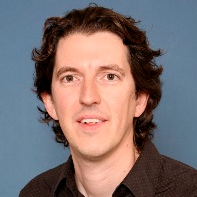
Screen Shot 2015-08-17 at 1.43.02 PMAlexander is Assistant Professor in Cultural and Historical Geography in the School of Geography at the University of Nottingham. His research addresses performance cultures, experimental geographies and the urban politics of interwar Germany, contemporary landscape photography, the wider geographies of neo-liberal globalisation and alternative urbanisms, and the history of squatting. Alexander has a forthcoming book in the RGS-IBG book series titled Metropolitan Preoccupations: The Spatial Politics of Squatting in Berlin, and two others in the works, including a monograph on the popular history of urban squatting in Europe and North America, and a co-edited collection on the geographies of forced evictions.
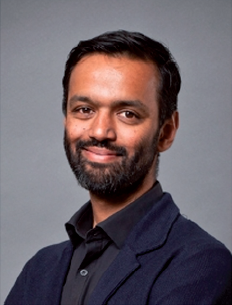
Screen Shot 2015-08-17 at 1.43.10 PMDarshan is Assistant Professor at the Department of Political Science and Centre for Urban Studies, University of Amsterdam. He is also a Senior Researcher at the African Centre for Migration and Society, University of the Witwatersrand, Johannesburg. Darshan’s research investigates how the state’s claim to territory has been reconfigured in response to changing patterns of human mobility. He brings with him intellectual interests in international politics, the regulation and policing of migrants, and territoriality. He is the author of Territory, Migration and the Evolution of the International System (Palgrave Macmillan, 2013), and co-editor of both Slavery, Migration and Contemporary Bondage in Africa (Africa World Press, 2013) and Mobility Makes States (University of Pennsylvania Press, 2015).

As the continuing editors, we welcome Alex and Darshan, and, with them on board, look forward to continuing to make the journal and its Open Site vibrant spaces for the publication of politically engaged and theoretically innovative work. In coming months, we will make announcements about changes at the Open Site, as well as editorial statements from the new collective on the journal’s short and medium term goals. So, more to come…

Deborah Cowen, Natalie Oswin, Mary Thomas
 

Society and Space early online articles and archives – all currently open access

Our new publisher, SAGE, has put up a number of papers in the early online section of the new Environment and Planning D: Society and Space site. Among these are several papers set to appear in the next issue of the journal, which will be published by the end of August. These include papers that will be part of a special issue on the theme ‘War, law and space’ (guest edited by Craig A. Jones and Michael Smith) by Craig A. Jones, Katia Snukal and Emily Gilbert, S.M. Reid-Henry, Mark Boyle and Audrey Kobayashi, and Rachel Hughes [additional pieces for that special issue by Zoltán Glück and John Morrissey are also available on the journal’s old site], as well as a stand-alone piece by Julian C.T. Barker on nightscapes and travel in 19th century India.

Also online early are papers by Kate Bedford and Fleur Johns, both of which will appear in a special issue on ‘The Politics of the List’ (guest edited by Marieke de Goede, Anna Leander and Gavin Sullivan) to be published in early 2016.

The remaining eight papers cover the politics of prison transfers within the British Penal Estate (by Luca Follis), the logics of visualization in immigrant integration in the Netherlands and Germany (by Sanne Boersma and Willem Schinkel), the politics of complexity and resistance in anti-genetically modified organism activism (by Leonie Ansems de Vries and Doerthe Rosenow), India’s mobile phone ecology as affective, human-technical assemblages (by Amit S. Rai), transformations to identity and social relations arising from the reinvention of airport infrastructures and facilities (by Anthony Elliott and David Radford), the exclusions and silences perpetuated by Vancouver’s recent Missing Women Commission of Inquiry (by Juliane Collard), human rights, sovereignty and postcoloniality in Pakistan’s tribal belt (by Muhammad Ali Nasir), and the ‘anxieties of control’ of our big data present (by Agnieszka Leszczynski).

All of these papers are currently available open access, as part of a free trial period with SAGE. Also available open access for a limited time are all of the Environment and Planning D: Society and Space archives from the first issue in 1983 to the most recent 2015 issue.

Volume 33, issue 3 now out

This is the first Society and Space issue with new publisher, SAGE. All contents are currently open access as part of a free trial period.

Situated solidarities and the practice of scholar-activism 391-407 Paul Routledge and Kate Driscoll Derickson
Zapatismo: other geographies circa “the end of the world” 408-424 Alvaro Reyes
After the pop-up games: London’s never-ending regeneration 425-443 Ameeth Vijay
Topologies of vulnerability and the proliferation of camp life 444-459 François Debrix
Contradiction, intervention, and urban low carbon transitions 460-476 Vanesa Castán Broto
On the political nature of cyanobacteria: intra-active collective politics in Loweswater, the English Lake District 477-493 Claire Waterton and Judith Tsouvalis
Securing and scaling resilient futures: neoliberation, infrastructure, and topologies of power 494-511 Daniel Sage, Pete Fussey, and Andrew Dainty
Resilience governance and ecosystemic space: a critical perspective on the EU approach to Internet security 512-527 Mareile Kaufmann
Disrupting migration stories: reading life histories through the lens of mobility and fixity 528-544 Ben Rogaly
Corporate personhood and the corporate body: the case of former energy giant Enron on trial for fraud 545-559 Jayme Walenta
Field recording and the sounding of spaces 560-576 Michael Gallagher


Society and Space free access period with new publisher

In May of this year, SAGE purchased Pion Ltd, the previous publisher of the Environment and Planning series of journals. We are pleased to announce that the new website of Environment and Planning D: Society and Space is now online, and that it currently offers the contents of the journal’s 2002-2014 volumes open access. The remainder of our archives, including the 1983-2001 and 2015 volumes will be added shortly. In the meantime, these contents are still available at the journal’s old Pion website.

Interview with Maurizio Ferraris by Peter Gratton

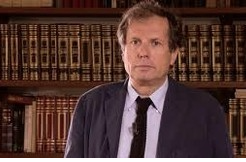
Screen Shot 2015-07-17 at 6.24.57 AMMaurizio Ferraris is one of the best-known and most important Italian philosophers writing today. A former student of Gianni Vattimo and collaborator with Jacques Derrida—he is perhaps best known to Anglophone audiences for their co-edited Taste for the Secret (Il gusto del segreto, first published in Italian in 1997)—Ferraris has been a longstanding professor of philosophy in the Department of Literature and Philosophy at the University of Turin. His work for some thirty years, dating to the early 1980s, developed through important interventions and reinterpretations of hermeneutics and then poststructuralist philosophy. (See a list of his dozens of works here.)

Peter Gratton, of the Department of Philosophy at Memorial University of Newfoundland, is a former co-editor and current editorial board member of Society and Space. His most recent book is Speculative Realism: Problems and Prospects (Bloomsbury, 2014), and he runs the blog Philosophy in a Time of Error.

The focus of the relatively short interview below is to introduce the controversial turn in Ferraris’ work to what he dubs a “new realism,” which finds him a kindred spirit to the speculative realists (Iain Hamilton Grant and Graham Harman have written forwards to the two English translations of his works this past year), as well as Markus Gabriel, whose realist theory of fields of sense has already made a mark in Germany, Italy, and elsewhere. Thanks to Sarah De Sanctis for translating the answers below.

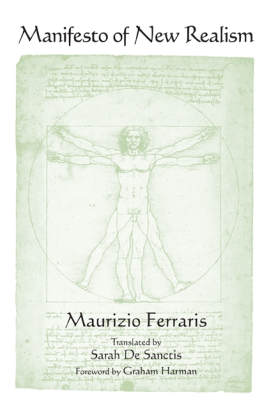
Screen Shot 2015-07-17 at 6.30.24 AMPeter Gratton: Both the Manifesto  and Introduction are clearly written and often humorous expositions of your “new realism” (you are also well served by an able translator), but for readers who have not had the chance to find these works yet, I thought I’d first ask you to summarize what you mean by your “new realism” and how it would be differentiated by previous realisms.

Maurizio Ferraris: My realism differs from previous ones only because it specifically reacts to postmodernism. Other forms of realism reacted to other forms of antirealism: to name one, for example, the 1912 American new realism criticized neo-​​K​anti​ani​sm. Each realism has its own anti-realism and responds to specific historical circumstances. As per my new realism, it reacts against the indiscriminate constructivism typical of postmodernism. There was a time when, so to speak,​ everything, including lakes and mountains, was taken to be socially constructed. Now, I have no difficulty in admitting that​, say,​ an invoice is socially constructed; perhaps in some ways (not all) things like ​charisma or beauty are socially constructed, too​. However, lakes and mountains certainly aren’t: it makes no sense, and to say (or even just ​suggest) this is to deprive philosophy of a​ll​ seriousness, turning it into a futile fairy tale.

Continue reading here.

Tagged , ,

Interview with Joseph Masco by Sonia Grant

Joseph Masco is Professor of Anthropology at the University of Chicago. He is the author of The Nuclear Borderlands: The Manhattan Project in Post-Cold War New Mexico, winner of the J. I. Staley Prize from the School for Advanced Research, the Rachel Carson Prize from the Society for the Social Studies of Science, and the Robert K. Merton Prize from the American Sociology Association. His current work examines the evolution of the national security state in the United States, with a particular focus on the interplay between affect, technology, and threat perception within a national public sphere.

Sonia Grant is a PhD student in the Department of Anthropology at the University of Chicago. Her work focuses on the environment and environmental regulations, and the rise of hydraulic fracturing (fracking) in the US, and her article “Securing tar sands circulation: risk, affect, and anticipating the Line 9 reversal” appears in Environment and Planning D: Society and Space 32(6). Sonia can be reached at soniagrant[at]uchicago.edu

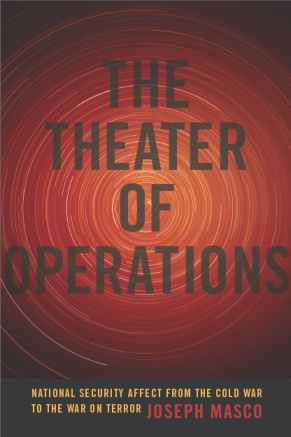
Screen Shot 2015-06-12 at 9.09.41 AMSonia Grant: Thank you for taking the time to talk about your new book, The Theater of Operations: National Security Affect from the Cold War to the War on Terror (2014). I’d like to start by getting a sense of what brought you to this project, and what kinds of continuities you see between it and your first book, The Nuclear Borderlands: The Manhattan Project in Post-Cold War New Mexico (2006). Both books engage with Cold War national security culture, technoscience, and secrecy, among other key themes. How did The Theater of Operations, as a project, develop for you? Did it feel like an obvious ‘next step’ from your work on the Manhattan Project?

Joseph Masco: While I was concluding fieldwork on The Nuclear Borderlands, the September 2001 attacks occurred and provoked a massive U.S. military buildup while renewing national fears of a nuclear catastrophe. White House officials were quick to declare a “new normal” of counterterrorism, marked explicitly as a radical break from Cold War notions of security. This rejection of deterrence, combined with an amplification of existential threats, were central themes in what became a pretty shocking militarization of American society. The War on Terror – as a political project — was a systematic attempt to create amnesia about the 20th century security state (and its prior actions in Iraq and Afghanistan) while at the same time using the familiar Cold War notion of nuclear danger to foment an existential crisis, one enabling quite radical actions around the world.

Some of the first conversations I had in Los Alamos in the early 1990s concerned the future of the laboratory, and of the U.S. nuclear weapons program more broadly, in light of the demise of the Soviet Union. At that time, U.S. weapons scientists were already talking about nuclear terrorism, the threat of radical forms of Islam, and, above all, were positing the arrival of a violent global adversary that could not be deterred. So, in a sense, the counter-terror state project was articulated to me almost a decade before the 9/11 attacks.

Continue reading here.

Tagged ,

Sacred Space Unbound – A Virtual Theme Issue

Society and Space review editor Veronica Della Dora has compiled a virtual theme issue on sacred space. Read the remainder of her introduction to the issue, as well as links to its contents (which are currently available open access), at the link below.

screen-shot-2013-12-15-at-2-12-57-pm

Photo: Orlando Woods

All religious belief implicates space; all religious practice makes geography. In the broader sense, the term ‘sacred’ indicates something ‘different’, ‘set apart’, ‘other’, as well as something to which is ascribed special meaning. Yet, where do the boundaries of the sacred lie? Is sacred space an ontological given, or is it a social construction? Is it a portion of territory, or is it the product of a set of practices? Is it something we walk on, or is it something we perform? Is it permanent or ephemeral? Is it private or public?

Over the past decades, geographers and other scholars from across the humanities and the social sciences have approached sacred space in different ways: as a well-defined space set in opposition to ‘the secular’; as a contested domain continuously articulated and rearticulated through performance; as a repository of powerful symbols and meanings; as a dynamic assemblage of materials, sounds, and human emotions. This virtual theme issue presents a small selection of articles published in Environment and Planning D: Society and Space and Environment and Planning A which have developed some interesting approaches to sacred space and which reflect some broader epistemological shifts occurred over the past twenty years. While the concept of the sacred has been often extended to non-religious spaces and rituals, especially in the context of memorialization and national identity making, for the purposes of this issue we will limit our selection to spaces associated to religion.

Continue reading here.

Change and continuity, again

Screen Shot 2015-06-01 at 11.35.31 PMStuart Elden became Editor of Environment and Planning D: Society and Space with the first issue of its 25th volume. Now, 8 and ½ years later, he is stepping down.

In his first editorial as Editor, titled Change and Continuity, Stuart set out three key aspects of his vision for the journal. First, he declared that Society and Space, “by the very nature of the questions it addresses is an inherently interdisciplinary journal”, and set his sights on expanding its reach across disciplinary boundaries. Second, he highlighted the journal’s aim “to be international in its focus, and to publish work coming from across the world”, alongside his wish to bring non-English debates to the journal’s readers through both submissions and translations. Third, he announced changes in submissions processing at EPD, changes that saw a decentralized editorial structure replaced with one in which Editor and Co-Editors vetted each submission collectively.

Stuart’s tireless efforts to cultivate the journal’s theoretical depth and quality have yielded dividends in each of these three areas: the interdisciplinary and international network of authors, reviewers, and contributors that Society and Space relies upon has certainly grown; he has especially brought in scholars working on continental theory and philosophy in a range of sites, and has facilitated the publication of numerous translations in the journal’s pages; and, the collective mode of working that he instituted at the beginning of his tenure with the journal worked so effectively that, in 2013, we moved from a structure of one lead Editor and several Co-Editors to a flat structure of several Editors who share all administrative and intellectual responsibilities equally.

Stuart’s efforts also extend well beyond the print journal. Most notably, he began this Open Site in 2011, and its growing audience year-on-year is a testament to his vision of the benefits and contributions of an open-access journal companion site. Further, he has remained keenly intent on fostering the work of junior scholars and graduate students behind the scenes.

We will sorely miss the collaborative spirit and energy that Stuart brought to the journal, and we thank him for his mentorship, friendship and collegiality. He has accepted our invitation to remain on the Society and Space masthead as an honorary editor, so our gratitude for his work and dedication will surely continue to grow. The journal will inevitably change as we bring on new team members in months to come. But, as Stuart noted when he started in 2007, we will likewise continue to try “to do what the journal does so well – publish challenging, well-written and theoretically innovative contributions to ongoing debates, as well as sparking fresh ideas and mapping new directions.”

Deborah Cowen, Natalie Oswin, Mary Thomas
Interview with Arnold L. Farr by Margath Walker – On critical theory, liberation and Herbert Marcuse

Margath Walker’s article “Borders, one-dimensionality, and illusion in the war on drugs” appears in issue 1 of volume 33 of Environment and Planning D: Society and Space. In it, she interrogates the war and drugs across North and South America by deploying Frankfurt School theorist Herbert Marcuse’s concept of one-dimensionality. As a supplement to the article, the following conversation with Arnold L. Farr, a philosopher who has looked to Marcuse to examine issues of race and justice in the United States, explores some of the important theoretical contributions of Marcuse. Walker’s article is now open access for one month.

Margath Walker: I would like to begin with a conversation about Marcuse and the ways in which you have been instrumental in bringing him to the forefront of theoretical discussions both in your own work and through the International Marcuse Society. Why should critical theorists be interested in Herbert Marcuse?

Arnold Farr: So, who is he? Well, of course he is a member of the famous Frankfort School for Social Research that was formed in Germany in the 1920s, all of whom were exiled to the US when Hitler came to power. Their lives were in danger. Walter Benjamin lost his life en route. The others came to the US. After the war, most of them returned although I believe Erich Fromm stayed in Mexico. Marcuse and Leo Lowenthal stayed in the US. They are famous for fusing Marx and Freudian psychoanalysis. They were concerned with the following question: why does it seem to be the case that the people who benefit most from a Marxist revolution and social change are most likely to resist it? It was Freud that helped them understand the way in which capitalism and other forms of economic and social systems can shape one’s psyche so one accepts oppression. In addition, Marcuse was a scholar of Hegel in terms of what we call dialectical thinking. One of his most important essays-“ A Note on Dialectics”- published in the 1960 edition of his second book on Hegel, Reason and Revolution, explains what dialectical thinking is for him. To think dialectically is to look at one’s society at any given moment and see in tandem the development of forces for liberation whereby the possibility of liberation is already there, and the forces for further oppression. And so society is never this static thing that simply has the present structure. There is something always contained within itself which provides possibilities for it being otherwise.

MW: What is compelling to you as a philosopher about Herbert Marcuse?

AF: Well, one of the things that drew me into philosophy was the freedom to think, I felt liberated just reading philosophical texts and learning how to think and to think critically. And I’ve always been concerned with issues of justice and, of course being African American from the South there’s the race issue. I have always been attracted to the kind of philosophy that helps me think about day to day problems and issues. Being one who is concerned with oppression and social justice, the Frankfurt School seems to give me the theoretical lenses for grappling with those issues more than almost any other philosophy that I know of. And Marcuse is particularly interesting because of his very profound critique, a critique that goes so deep that sometimes it sounds pessimistic but it’s not because even as he explains the social mechanisms that are in place to prevent any kind of social change and liberation at the same time he’s quite aware of developing possibilities for liberation. So, he’ll write a book like One-Dimensional Man where he’s describing our society as one-dimensional and there are all these mechanisms for what he’ll call putting subjectivity or thought under erasure. Whereas he’ll then write a book like An Essay on Liberation focused on the mechanisms in our society that are mechanisms for liberation.

Continue reading here.

Linnet Taylor – Towards a contextual and inclusive data studies: a response to Dalton and Thatcher

Linnet Taylor, University of Amsterdam, offers the following commentary as a response to Craig Dalton and Jim Thatcher’s piece on this site, “What does a critical data studies look like, and why do we care? Seven points for a critical approach to ‘big data.”


The social sciences are engaged in a trans-disciplinary debate on the meaning and use of new forms of digital data. One of the most important repercussions from Dalton and Thatcher’s call (2014) for a critical data studies has been an awareness that researchers need to continually sensitise themselves to the contextualities of data’s production and use (Kitchin 2014, Graham and Shelton 2013, Nissenbaum 2010). This short essay responds to this ongoing debate, laying out the case for such an awareness and asking how we might better operationalise it in data studies. If researchers working with the new data sources – and geographers in particular – can learn to think across contexts in a more inclusive way, it may take us further toward realising big data’s promise as a tool for social scientific research.

Like Dalton and Thatcher, I use the terminology of ‘big data’ as central to the process of imagining a more contextually aware data studies, since it is precisely because of ‘bigness’ that context tends to disappear. ‘Big’ can easily become a synonym for ‘universal’ in ways that can be both unreflexive and insidious. For instance, a focus on the analytical challenges of large and complex datsets tends to crowd out a more inclusive perspective in favour of a focus on the most active online population – the US – because it provides the greatest breadth of data. ‘Big’ is powerful, it is epistemologically deterministic (Cherlet 2013), and it suggests a truthiness that gets in the way of reflexivity.

Continue reading here.

Follow

Get every new post delivered to your Inbox.

Join 6,251 other followers