Lauren Berlant’s Society and Space lecture at the #AAG2015 – forthcoming in the journal

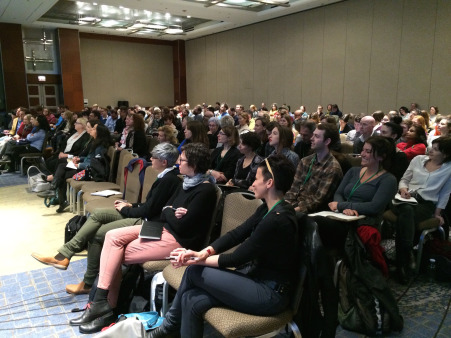
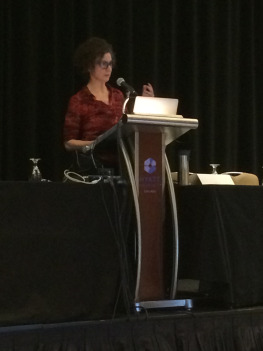
BerlantLaurent Berlant gave the Society and Space lecture at the Association of American Geographers meeting in Chicago on Friday 24 April 2015. Entitled ‘Sensing the Commons’, it ranged from affect to political theory, infrastructure to austerity. There was a large audience for the dense, nuanced, and fascinating lecture, and some discussion time afterwards for questions and challenges. The lecture will appear in a future issue of the journal. Many thanks to Lauren for the wonderful event, and for all of you who came out to engage with feminist and queer thought and to support the journal.

Update: Jen Jack Gieseking has put together a Storify of the tweets about this talk.Crowd

Tagged ,

Alex Papadopoulos on Alexis Tsipras’s speech to the Greek Parliament

Before the Greek elections Society and Space hosted a mini forum on the possibilities and challenges to come. We now have the first of hopefully a series of contributions reflecting on the situation since SYRIZA’s victory. Alex Papadopolous writes on “Alexis  Tsipras’ Historic Greek Parliament Speech in Support of Social Democracy – Against Neoliberalism“:

The Prime Minister of Greece and leader of the radical left party SYRIZA, Alexis Tsipras, delivered a major speech that addressed the near totality of domestic and foreign policy issues in the country’s political scene. Important questions about the separation of Church and State and LGBT rights—both in the party platform—were not covered, likely to placate the conservative coalition partner, the Independent Greeks. In certain respects this was business as usual, as a newly elected government commonly presents its program in a ‘state of the union-to-be’ sense to the Parliament and then seeks a vote of confidence. The affirmation of the Government and its program in at least a symbolic sense (since it is largely aspirational in character at this early point) signals the beginning of the legislative season.

continue reading here.

The previous posts in the forum were:

John Agnew (Geography, UCLA) – Ordnungspolitik: Germany’s Shadow over the Greek Election

Peter Bratsis (Political Science, CUNY) – The Greek Elections and the Rebirth of Europe as a Political Space

Costas Douzinas (Law/Institute for the Humanities, Birkbeck) – Greece and the Future of Europe

Antonis Vradis (Geography, Durham) – In-between Spaces

The Greek Elections and the Future of Europe – a Society and Space forum

With the Greek elections just a few days away, and Syriza leading the polls, we have asked a number of people to write commentaries on the prospects for Greece and the rest of Europe. The first four posts are now available:

John Agnew (Geography, UCLA) – Ordnungspolitik: Germany’s Shadow over the Greek Election

Peter Bratsis (Political Science, CUNY) – The Greek Elections and the Rebirth of Europe as a Political Space

Costas Douzinas (Law/Institute for the Humanities, Birkbeck) – Greece and the Future of Europe

Antonis Vradis (Geography, Durham) – In-between Spaces

The Editors

Doing Theory Slowly: more on media, practices and urban politics

stuartelden:

Clive Barnett with some more detail about the conversation on ‘Slow Theory’, and how the project has developed.

Originally posted on Pop Theory:

9484-aldabra-giant-tortoise-1920x1200-animal-wallpaperFollowing up on the link to the Society and Space page with the podcast of a discussion between myself, Scott Rodgers, Allan Cochrane and Tim Markham, I thought it would be useful to recall the ‘arc’ of the conversations that Scott, Allan and I have been having since 2007. The podcast mentions the idea of ‘slow theory’ (an idea we might have stolen from a former OU colleague, Mike Saward), which is one way of capturing the process of collaborative thinking that we have been involved in that time.

– This all started when Scott was an ESRC-funded post-doc at the OU, from 2007-8, and then in turn working at CCIG at the OU.

-As part of the initial project, we held a workshop on the theme of Mediapolis, in June 2008.

– That generated the first published output of the collaboration, an edited section of the

View original 199 more words

Michael Watts interview at Society and Space – fixed the broken link

Apologies for the earlier broken link to the interview – now fixed and available here…

Michael Watts is Class of 1963 Professor of Geography and Development Studies at University of California, Berkeley. He is the author and editor of a number of important studies of Nigeria, geopolitics, political violence and ecology. He was awarded the Victoria medal of the Royal Geographical Society in 2004 “for research on political economy, culture and power”. He is interviewed by Society and Space editor, Stuart Elden, here.

Niger delta 2007

Niger delta 2007

Interview with Michael Watts – on Nigeria, political ecology, geographies of violence, and the history of the discipline

Michael Watts is Class of 1963 Professor of Geography and Development Studies at University of California, Berkeley. He is the author and editor of a number of important studies of Nigeria, geopolitics, political violence and ecology. He was awarded the Victoria medal of the Royal Geographical Society in 2004 “for research on political economy, culture and power”. He is interviewed by Society and Space editor, Stuart Elden, here.

Niger delta 2007

Niger delta 2007

Stuart Elden: You went to northern Nigeria in 1976 for your doctoral research. The dissertation and book that resulted from this – Silent Violence: Food, Famine, and Peasantry in Northern Nigeria (University of California Press, 1983) – has recently been reissued by University of Georgia Press. I want to discuss your more recent work on Nigeria and contemporary politics in the country in a moment, but first, can I ask you to reflect a bit on the Silent Violence book? What made you chose Nigeria as a country to work on, and how did you feel returning to the material to write the introduction for the new edition of the book after thirty years?

Michael Watts: First of all Stuart, let me thanks you for providing an opportunity for you and I to discuss my work, and I hope, contemporary Geography on both sides of the Atlantic. A short answer to your question is that in the first case it was something of an accident and in the second Nigeria became for me, and many others who encountered it, a country – or a ‘profession as some commentators have said –a space of compelling interest and fascination. Yes, its a bit of a train wreck, endlessly dispiriting, always surprising, unpredictable – who knew that Nigeria would in the last few weeks be praised for its ‘world class response’ to the Ebola outbreaks in Lagos and Port Harcourt!! – and a country of such enormous and unrelenting energy and creativity that it has been hard to walk away from. It would be fair to say I’ve only worked in one place over the last thirty-five years, and indeed felt no need to work elsewhere (it is true I have dabbled a bit in California, Vietnam, The Gambia and India but these proved to be little more than diversions). I actually went up to University College, London in the late 1960s to read Geography. I was raised in a small village in the south west of England, neither of my parents pursued secondary education school after the age of sixteen and joining the professoriate never entered my consciousness until I moved across the Atlantic…

continue reading here

Tagged , , , , , , ,

Marijn Nieuwenhuis on “The Terror in the Air” at Open Democracy

stuartelden:

Peter Gratton links Marijn Nieuwenhuis’s recent Open Democracy commentary to a piece on this site by Marijn, and Peter Sloterdijk’s ‘Airquakes’ piece, translated for the journal back in 2009 and available open access.

Originally posted on PHILOSOPHY IN A TIME OF ERROR:

An interesting article here. Nieuwenhuis previously had a piece on Society and Space‘s open site “Terror in the Air in Istanbul” earlier this year. Sloterdijk’s 2009 S&S article “Airquakes,” which provides some of the background to the two commentaries, is still available open access.

View original

Eyal Weizman interview, film screening, Society and Space lecture and review of Forensis forthcoming

An interesting interview with Eyal Weizman, ahead of a screening of the film ‘The Architecture of Violence’at SOAS Khalili Lecture Theatre at 7.15pm on 5 December as part of the London Palestine Film Festival. After the documentary Weizman will be speaking on Architecture and Violence after Gaza.

Eyal gave the 30th anniversary Society and Space lecture at the Royal Geographical Society (with IBG) conference at the University of Edinburgh in 2012. A review essay by Gastón Gordillo of the Forensis collection Eyal directed is forthcoming in the journal in 2015. Gastón has posted the introduction of this essay on his Space and Politics blog.

Peter Gratton, Speculative Realism – and links to journal articles on this theme

Society and Space board member and former co-editor Peter Gratton’s new book, Speculative Realism: Problems and Prospects is now published.
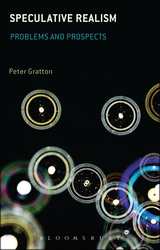
9781441174758

Speculative realism is one of the most talked-about movements in recent Continental philosophy. It has been discussed widely amongst the younger generation of Continental philosophers seeking new philosophical approaches and promises to form the cornerstone of future debates in the field.

This book introduces the contexts out of which speculative realism has emerged and provides an overview of the major contributors and latest developments. It guides the reader through the important questions asked by realism (what can I know? what is reality?), examining philosophy’s perennial questions in new ways. The book begins with the speculative realist’s critique of ‘correlationism’, the view that we can never reach what is real beneath our language systems, our means for perception, or our finite manner of being-in-the-world. It goes on to critically review the work of the movement’s most important thinkers, including Quentin Meillassoux, Ray Brassier, and Graham Harman, but also other important writers such as Jane Bennett and Catherine Malabou whose writings delineate alternative approaches to the real. It interrogates the crucial questions these thinkers have raised and concludes with a look toward the future of speculative realism, especially as it relates to the reality of time.

The journal has published some related work on these themes, including

Graham Harman, 2010, “I am also of the opinion that materialism must be destroyed” Environment and Planning D: Society and Space 28(5) 772 – 790 [open access]

Quentin Meillassoux, 2012, “The contingency of the laws of nature” Environment and Planning D: Society and Space 30(2) 322 – 334

Yusoff K, Grosz E, Clark N, Saldanha A, Nash C, 2012, “Geopower: a panel on Elizabeth Grosz’s Chaos, Territory, Art: Deleuze and the Framing of the EarthEnvironment and Planning D: Society and Space 30(6) 971 – 988

There have also been some related posts on this site, including

Two reviews of Catherine Malabou’s books – Ontology of the Accident (2012), reviewed by Stacey Smith; and Changing Difference (2011), reviewed by Sarah Kuzuk.

Jane Bennett, Vibrant Matter, reviewed by Noel Castree

Book Forum on Ben Woodard, On an Ungrounded Earth, reviewed by Kai Bosworth, Harlan Morehouse, Rory Rowan and Jordan Skinner

Farewell Kathy Wood; welcome Kiersty Hong

Kathy Wood

Kathy Wood

After eight years of work on the journal, we bid a fond farewell to Kathy Wood. Kathy works in the research office of Durham University’s Geography department and started work on the journal when Stuart Elden became editor in late 2006. As journal manager she has processed hundreds of manuscripts, and dealt with authors, referees and production staff at Pion. It’s a largely invisible role – few of the co-editors or board, let alone our authors, have ever met her – but indispensable to the running of the journal. When Kathy was appointed, the journal moved from paper submissions (with mailed requests to referee) to an all electronic system; in the last couple of years she has been crucial to our shift to Manuscript Central for submission processing. We want to put on record our sincere thanks to Kathy for all of her hard work over these years, and to wish her good luck with her new role at Durham.

Kiersty Hong

Kiersty Hong

The journal’s editorial office has now moved to University of Toronto, and we are pleased to welcome Kiersty Hong as the new editorial manager. Kiersty was previously Undergraduate Program Assistant in Geography at University of Toronto; chief editor of a university newspaper; and a policy analyst intern with the Atlantic Council of Canada. She brings a wealth of academic, community and volunteer experience to the editorial manager role. Her work will include all of Kathy’s previous duties, but she will also be taking on an important role with our open site – www.societyandspace.com We have been working with Kiersty over the last few weeks and are looking forward to future developments.

The new email address for all administrative issues is [email protected] Papers should still be submitted in the usual way, through http://mc04.manuscriptcentral.com/societyandspace
Deborah, Stuart, Natalie, Mary
Follow

Get every new post delivered to your Inbox.

Join 6,251 other followers