Issue 2 of the 2015 volume of Environment and Planning D: Society and Space will go to press soon. In the meantime, many of the papers slated for that issue are up online:
In Encountering Occupy London: boundary making and the territoriality of urban activism, Sam Halvorsen situates an examination of Occupy London within literatures on boundary-making, and argues that Occupy’s practices of encountering provide ways to rethink the production of territoriality.
Practices of encountering are also examined in Elizabeth Johnson’s Of lobsters, laboratories, and war: animal studies and the temporality of more-than-human encounters. Through a reflection on field notes from an ethnographic encounter with lobster experimentation, she argues for the need to examine wider temporal and spatial relations, and particularly political economies, as important elements in any encounter.
Living absence: the strange geographies of missing people, by Hester Parr, Olivia Stevenson, Nick Fyfe and Penny Woolnough, seeks to understand urban geographies of absence through an analyses of the restaged testimonies of ‘missing people’.
Juanita Sundberg’s The state of exception and the imperial way of life in the United States-Mexico borderlands situates recent events in the US–Mexico borderlands in relation to modalities of power used in the expansion of US imperial hegemony, in order to support ongoing efforts to forge coalitions better able to contest legal suspension as a predominant technique of government.
In Cross-border marriage, transgovernmental friction, and waiting, Juan Zhang, Melody Chia-Wen Lu and Brenda S A Yeoh likewise consider governmental rationalities around border-crossing, here in relation to the experiences of Chinese marriage migrants in Singapore. [Note: for more papers on the governance of migration flows, see the virtual theme issue on International Immigration on this site]
In Wet ontologies, fluid spaces: giving depth to volume through oceanic thinking, Philip Steinberg and Kimberley Peters expand on work on volume that seeks to destabilise static, bordered, and linear framings of place, territory, and time, arguing that a ‘wet ontology’ can reinvigorate, redirect, and reshape debates that are restricted by terrestrial limits.
Finally, Jordan Fox Besek’s Neoliberal Niagara? Examining the political history of fish consumption advisories in New York State examines the ways that conservationist and neoliberal logics converge in environmental policies geared towards support for recreational anglers rather than those who fish for subsistence.
Also up early online are two papers that will appear in theme issue titled ‘War, law and space’ (guest edited by Craig Jones and Michael Smith) that will be published later this year:
Zoltán Glück’s Piracy and the production of security space utilizes Foucault’s analysis of security and Marx’s analysis of capital circulation to offer an analysis of the new institutional patchwork of ‘counterpiracy’. And, in Securitizing instability: the US military and full spectrum operations, John Morrissey examines the recent broadening of the US military’s overseas mission into what it calls ‘full spectrum operations’ and critiques how it is being enabled by what he terms ‘full spectrum law’.

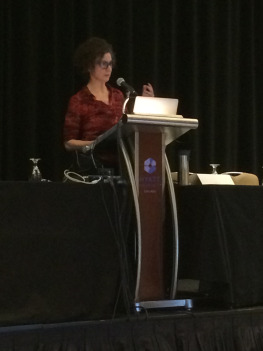 Laurent Berlant gave the Society and Space lecture at the Association of American Geographers meeting in Chicago on Friday 24 April 2015. Entitled ‘Sensing the Commons’, it ranged from affect to political theory, infrastructure to austerity. There was a large audience for the dense, nuanced, and fascinating lecture, and some discussion time afterwards for questions and challenges. The lecture will appear in a future issue of the journal. Many thanks to Lauren for the wonderful event, and for all of you who came out to engage with feminist and queer thought and to support the journal.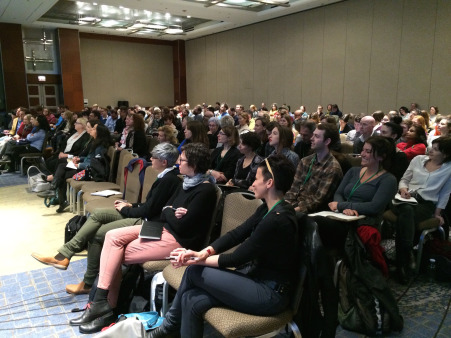
 We are delighted to announce that Lauren Berlant will give the 2015 Society and Space Lecture at the AAG in Chicago. The talk is entitled: