Free the map: Gazing at Belting’s Anthropology of Images from a map studies perspective

k9550Tania Rossetto reflects on Hans Belting’s An Anthropology of Images: Picture, Medium, Body through a map studies perspective. The book was originally published in German in 2001 with the title Bild-Anthropologie: Entwürfe für eine Bildwissenschaft and first translated into English by Thomas Dunlap in 2011. A new paperback edition by Princeton University Press appeared last year.

Recently, there has been some insistence on the need to include images as objects of study within geographical research inspired by non-representational theories. While digging through promising non-representational theories, Ben Anderson and Paul Harrison felt the need to specify that “everything happens, everything acts. Everything, including images, words and texts” (2010, page 14). While discussing photography in urban studies, Gillian Rose recently identified the shift towards a consideration of images as more than representational: an approach that requires a “bodily and emotional stance rather than interpretive or hermeneutic work” (2014, page 9). The geographies of embodiment, multisensoriality and practice, thus, include work on images, provided that those images are thought of as performative, relational, corporeal and affective. In this apparently paradoxical inclusion (the nexus of body-image) lies one of the main points of interest in Hans Belting’s book from the point of view of current cultural geographical debates. The leitmotif of this book, well emphasized by the subtitle chosen for the English version, is in fact the relationship between bodies and images, and in particular, the idea of considering the human body to be a living medium for images.

For Belting, art history has alienated the image from the body. First published in Germany in 2001, his book appeared as an intervention (or a manifesto) directed mainly at art historians, with the precise aim of contesting the established idea of the work of art in favour of a wider notion of Bild (which in German means both ‘image’ and ‘picture’, but is used here in the sense of ‘image’). Advancing the need for a “science of the image” (Bildwissenschaft) in order to transcend the borders of art history, Belting was contributing to the field of studies now identified as visual culture studies, visual studies or image studies (with distinctions from the field of media theory, as he maintains). An Italian image theory reader (Pinotti and Somaini 2009), for instance, includes Belting among scholars like W.J.T. Mitchell, Gottfried Boehm, James Elkins, Louis Marin and David Freedberg, while presenting the polyvocal reflection on the set of problems inherent to the image which animates contemporary debate.

In this review, however, I do not wish to directly engage with the (already much discussed and criticized) contributions of an influential scholar (for example, see Wood 2004). Instead, I would like to direct an oblique gaze on this book by adopting the perspective of the map scholar. Continue reading Tania’s review here.
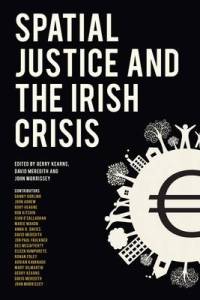
Spatial Justice and the Irish Crisis reviewed

9781908996367Denis Linehan reviews Spatial Justice and the Irish Crisis, a volume edited by Gerry Kearns, David Meredith and John Morrissey and published by the Royal Irish Academy in 2014.

Spatial Justice and the Irish Crisis is an important collection of geographical essays which provides a coherent and sustained critique of the 2008 crisis and its impacts on Ireland. Building on research projects by its main contributors, the volume aims at identifying the injustices found in the underlying spatial structure of Irish social life. The collection also opens a debate on the application and use of the phrase ‘spatial justice’, offering throughout reflections on its merits, potential and applications. Continue reading Denis’ review here.

A promontory perspective on ‘multiple modernities’: Baker on Hansen

Julian Baker reviews Peter Hansen’s The Summits of Modern Man: Mountaineering after the Enlightenment (Harvard University Press, 2013).

Today, the bald peak of Mont Ventoux rises white and treeless above the vineyards of Provence, an hour’s drive northeast of Avignon, capped with a weather station and the goal of visiting cyclists. In 1336 the Italian poet Francesco Petrarch climbed to this summit and contemplated the view. Later, after a reviving supper at his inn, he wrote out his experiences. For five hundred years readers paid little notice to the climb. Rather, Petrarch became famous for his lyrical sonnets and rediscovery of Cicero’s letters. Then, in 1860, the Swiss historian Jacob Burckhardt identified Petrarch, for his inclination to climb a peak for the aesthetic fulfillment of the scenery, as the first “modern man”.

This overlap of ascent, identity and modernity is the subject of Peter Hansen’s The Summits of Modern Man. Through a selective history of mountaineering, Hansen attempts to explain “a particular strand of modernity in which modern man stands alone on the summit, autonomous from other men and dominant over nature” (page 2). Continue reading Julian’s review here.

Tagged , ,

Putting Urban Planning on the Couch: review forum on Westin’s The Paradoxes of Planning

9781409448037.PPC_Series 1357Jamie Doucette (University of Manchester) and Christian Abrahamsson (University of Oslo) organized an author-meets-critics forum on Sara Westin’s book The Paradoxes of Planning: A Psycho-Analytical Perspective  (Ashgate, 2014) for the Chicago AAG earlier this year. Three reviews of the book are posted on the open site by Andrew Shmuely, Jesse Proudfoot, and Mark Davidson, with an introduction to the forum provided by Jamie Doucette and Sara Westin’s reply.

Transnationalisms: two new reviews

Reviews of the following two books are now published on the Open Site:

First is Sofie Narbed’s review of Amanda Rogers’ new monograph Performing Asian Transnationalisms: Theatre, Identity and the Geographies of Performance (Routledge, 2015).

Second is Zhuyun Amy Zang’s review of Ato Quayson’s Oxford Street, Accra: City Life and the Itineraries of Transnationalism (Duke University Press, 2014).

At the edges of the state: Bichsel on Reeves’ Border Work

reveesChristine Bichsel reviews Madeleine Reeves’ monograph Border Work: Spatial Lives of the State in Rural Central Asia. The book came out with Cornell University Press last year.

The cover picture of Madeleine Reeves’ book Border Work shows a wagon on wheels standing on a dusty roadside. The wagon is painted in military camouflage patterns. Its colours resemble those of an aerial photograph of the Ferghana Valley, with its green irrigated areas, brown dry hills, white snow-capped mountains, and blue bodies of water. “Kyrgyzstan” features in Cyrillic characters on the wagon’s road-facing side. On the back of the wagon is a barely visible inscription. It says that this is the border control post of Samarkandek, a village located on the Kyrgyzstan-Tajikistan border. In the foreground we see two women and a man, probably waiting for a lift to visit relatives or friends. No border personnel are visible in the picture. We are left to wonder if this post is actually manned, and if control procedures are in place. There is no indication of where Kyrgyzstan and Tajikistan respectively lie either. What is more, the picture conveys considerable uncertainty as to whether we would still find the wagon in the same place the next morning, or if it would have wheeled off to a different spot. Continue reading Christine’s review here.

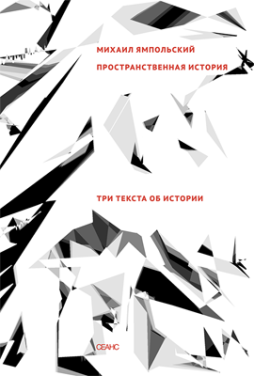
The Spatial History: Maksakov on Yampolsky

JampolskijVladimir Maksakov reviews Пространственная история. Три текста об истории/ Prostranstvennaya istoria. Tri teksta ob istorii [The Spatial History. Three Texts on History] by Russian historian Mikhail Yampolsky. The book was published by Masterskaya Seans Press in 2013.

Spatial History, the title of Mikhail Yampolsky’s new book, evokes a vertical, rather than horizontal (or chronological), approach to history. The idea that historical process (and the writing of history) contains some focal points which allow one to take the gist of the events and deploy the logic of history in depth rather than in breadth is not new in principle. According to Yampolsky, the idea of progress at the basis of text teleology can be traced all the way back to ancient historians. Their aim was to show the history of the rise and exaltation of Rome, or, on the contrary, the decline of Greece. Here, textual coherence and narrative began to dictate their terms. Such works contained the concept of time at the level of plot, which implicitly led to a particular purpose. To avoid this in his own work, Yampolsky chooses an unconventional narrative. Spatial History consists of interconnected essays crafted from different materials from all areas of the humanities and are linked to major philosophers, historians, philologists, art historians, writers, poets, and architects. Continue reading Vladimir’s review here.

ANTI-CRISIS REVIEWED

978-0-8223-5527-4_prLuca Follis reviews Janet Roitman’s book Anti-Crisis (Duke University Press, 2014).

We live in times of crisis, or so it would seem. News reports daily confirm the intractability of enduring geo-political predicaments (e.g., in Afghanistan and Iraq) and the emergence of new situations announced as historical turning points (e.g., Syria and ISIS, Greece and the EU, Ebola) to say nothing of the variegated, post-facto accounting of decision making and action during emergencies (e.g., the recent political wrangling over the USA Freedom Act or the US Senate’s Report on CIA Torture operations). Political, institutional, financial and humanitarian crises abound and they proliferate at a seemingly unchecked pace. But is this global state of affairs merely a reflection of a historical, empirical moment or is it an expression of the ease and haste with which we label events as critical (and by extension the way we approach the broader category of crisis)? Continue reading Luca’s review here.

Cartographic mirages: Ferretti on Blais

9782213677620-X_0Federico Ferretti reviews Hélène Blais’ Mirages de la carte, l’invention de l’Algérie coloniale, XIXe – XXe siècle [Mirages of the Map: The Invention of Colonial Algeria, 19th-20th c.]. The book came out last year with Fayard.

Hélène Blais’ Mirages de la carte explores the geographical invention of Algeria during the French empire. The book interrogates the role of maps and surveys in the construction of a national image which was subsequently largely recovered by independent Algeria in the 1960s. This very rich and well-documented monograph is based on primary sources like maps and texts by French geographers and surveyors who worked in Algeria during the colonial period (1830-1962) and archive documents linked to their activities, mainly from the Archives Nationales d’Outre Mer and the Service Historique de la Défense. Drawing on French and international literature on geography and empire, Blais stresses the necessity to understand the field experiences through which “space practices take part in colonial politics” (page 10). The imposition of the imperial map, she argues, was not an all-powerful operation, but involved several conflicts and adaptations. Continue reading Federico’s review here.

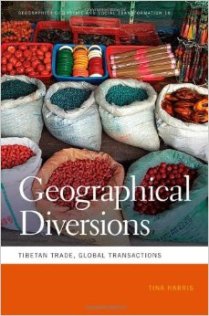
Uneven trading: Gieseking on Harris

514Q9dxdL3L._SY344_BO1,204,203,200_Jen Jack Gieseking reviews Tina Harris’ monograph Geographical Diversions: Tibetan Trade, Global Transactions (University of Georgia Press, 2013). Geographical Diversions is a well written ethnographic contribution to the study of mobilities, fixities, and trade, with a focus on trade routes in Nepal, Tibet (or Tibetan Autonomous Region, i.e. TAR), India, and China. In her first monograph, anthropologist and geographer Tina Harris traces the “properties, spatial origins, and trajectories of commodities” that serve to fix some geographies while rendering others mobile and free. Moving between ethnographic thick descriptions of traders’ precarious stop and start movements over dangerous and shifting routes, dull-yet-revitalized British colonial diaries, local and international newspaper clippings and archival records, and interviews with traders, the book is a dialogue between geocultural and geopolitical economies of those living and trading across national, regional, and local scales. Continue reading here.

Follow

Get every new post delivered to your Inbox.

Join 6,251 other followers