The more-than-real and the Anthropocene – Jess McLean

The following text is offered by Jess McLean as a supplement to her forthcoming Environment and Planning D: Society and Space article, The contingency of change in the Anthropocene: More-than-real renegotiation of power relations in climate change institutional transformation in Australia. In the piece, which is currently free to access in the online first section of the journal webpage, McLean analyses the creation of a crowdfunded climate change institution in Australia – the Climate Council – as an instance of everyday activism in the Anthropocene, and partly a function of the more-than-real.

Can the desire to do something in digital spaces, like social media, produce social changes that are effective, and can the Anthropocene concept accommodate these? I explore these two questions in my Environment and Planning D: Society and Space article, “The contingency of change in the Anthropocene: More-than-real renegotiation of power relations in climate change institutional transformation in Australia”.

The Anthropocene, the era geologists are stating we are in as a result of humanity’s environmental impacts, is a contested notion. There is dispute over how we should definition this era and whether it is even a useful idea. However, Cook et al (2015) argue that ‘More important than the issue of its definition are the moral, cultural, and political challenges that the Anthropocene is amplifying.’ (Cook et al, 2015: 231). In the Society and Space article, I traced some of the challenges amplified by the Anthropocene, including how we respond to our understanding of our environmental responsibilities and whether we can do anything substantive in the digital realm about climate change.

We sometimes still talk about how digital spaces are not real, that they are functions of the virtual (Kinsley, 2014). The acronym IRL captures this as we say to Facebook friends or Twitter associates – this would be different in real life. And in some ways it would be different if we were face-to-face, or side-by-side, but that fact doesn’t make digital spaces any less real. If anything, their excessive power – both corrosive and generative – forge them as more-than-real. And just as risky.

Continue reading here

Michele Lancione on “Metropolitan Preoccupations: The Spatial Politics of Squatting in Berlin” by Alexander Vasudevan

vasudevan_metropolitan preoccupationsThere are two main streams at play in Alexander Vasudevan’s latest book, Metropolitan Preoccupations: The Spatial Politics of Squatting in Berlin. The first is about the cultural and political geographies of squatting in the city, of which this text, as the author reminds us, represents the first book-length study available. The second is about the analytics that Vasudevan employs to narrate those stories and geographies. If the former makes for a very informative read and an invaluable resource for further studies on Berlin, it is within the latter that the true merit of this text resides.

This book is not simply about “squatting” in Berlin. Rather, it is a masterful exercise in geography: the careful tracing and detailed writing of histories, events, bodies, materialities and atmospheres and of their nuanced capacities, debris, and paths. To some extent, this is a textbook. In reading it we can perceive the excruciating dedication of its author in avoiding over-theorisations; in trying to narrate occupation as a universe of heterogeneities rather than only through the voice of its leaders; in laying out a history that is also a geography, and a geography that takes its historical lineages seriously. Maintaining a clear analytical lucidity throughout the dense 242 pages of text in this monograph, as Vasudevan does, is not an easy task, and he deserves praise and attention.

Continue reading here

Tagged , , , , ,

Lindsey McCarthy on “The Value of Homelessness: Managing Surplus Life in the United States” by Craig Willse

willse_value of homelessness Lindsey McCarthy reviews Craig Willse’s monograph The Value of Homelessness: Managing Surplus Life in the United States (University of Minnesota Press 2015).

Craig Willse’s book The Value of Homelessness confronts the everyday, taken-for-granted, and accepted wisdoms surrounding housing insecurity and deprivation in the United States. It confronts us too, as well as forcing us to confront those from whom we frequently turn away. From the stark book title and cover image to the powerful prose and theory, The Value of Homelessness: Managing Surplus Life in the United States inspires us to ask different questions about housing deprivation. The term “surplus life”—a darker, Foucauldian variation of the Marxist notion of surplus labour—directs our attention to the parallels between those intentionally kept out of the labour market to drive up competition for low-wage jobs under capitalism and those assigned to the category “homeless,” who are made into economically and socially productive matter. For Willse, housing deprivation is not an unintended consequence of but a way to make room for the “urban consumer economies of neoliberal capital” (page 11).

Continue reading here

Tagged , , , ,

Review of Liisa H. Malkki’s The Need to Help: The Domestic Arts of International Humanitarianism

Malkki_Need to HelpRitu Mathur reviews Liisa H. Malkki’s monograph The Need to Help: The Domestic Arts of International Humanitarianism (Duke University Press 2015).

To remove the varnish from the “gloss” of humanitarianism this book poses a simple question: “who ‘the needy’ are in the humanitarian encounter”? The thoughtfulness with which this question is posed demonstrates Liisa Malkki’s unwillingness to take assumptions about the neediness of the Global South for granted. On the contrary she situates her ethnographic fieldwork in Finland: a country known for its neutrality, where a large number of the population devotes its time to voluntary service and the Finnish Red Cross holds special influence and prestige.

Continue reading here

Tagged , , , , , ,

Society and Space ‘Politics of the list’ theme issue now online

The first issue of the 2016 volume of Environment and Planning D: Society and Space (volume 34, number 1) is now online. It includes an excellent theme issue edited by Marieke de Goede, Anna Leander and Gavin Sullivan on ‘The politics of the list’, as well as two fascinating stand-alone articles – one by Andreas Philippopoulos-Mihalopoulos on the ontology of atmosphere, the other by Neve Gordon and Nicola Perugini on the politics of human shielding.

The guest editors’ introduction to the theme issue is free to access for the next month. The remaining contents require subscription to access, but see a freely available photo essay by Gordon and Perugini as a supplement to their article here.

The politics of the list: Law, security, technology theme issue
Guest editorial: The politics of the list Marieke de Goede, Anna Leander, Gavin Sullivan 3-13
Indexing – The politics of invisibility Urs Stäheli 14-29
Letting the right ones in: Whitelists, jurisdictional reputation, and the racial dynamis of online gambling regulation Kate Bedford 30-47
The politics of whitelisting: Regulatory work and topologies in commercial security Anna Leander 48-66
The politics of security lists Marieke de Goede and Gavin Sullivan 67-88
The cross-colonization of finance and security through lists: Banking policing in the UK and India Anthony Amicelle and Elida KU Jacobsen 89-106
Keep adding: On kill lists, drone warfare and the politics of databases Jutta Weber 107-125
Global governance through the pairing of list and algorithm Fleur Johns 126-149

Withdrawing from atmosphere: An ontology of air partitioning and affective engineering Andreas Philippopoulos-Mihalopoulos 150-167
The politics of human shielding: On the resignification of space and the constitution of civilians as shields in liberal wars Neve Gordon and Nicola Perugini 168-187

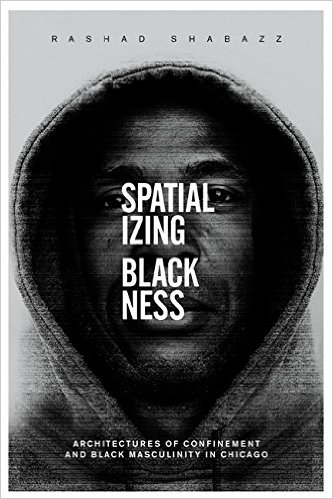
Spatializing Blackness: Syedullah on Shabazz

Shabazz_Spatializing BlacknessJasmine Syedullah reviews Rashad Shabazz’s monograph, Spatializing Blackness: Architectures of Confinement and Black Masculinity in Chicago (University of Illinois Press, 2015).

Rashad Shabazz’s Spatializing Blackness: Architectures of Confinement and Black Masculinity in Chicago maps a historical landscape of the everyday contradictions of Black life, laying bear the blind corners and liminal spaces of “possibility and punishment”—the places of precarity, criminalization, and confinement so many call home (page 69). Drawing out both the causal and structural links that conjoin the underdevelopment of Black neighborhoods and the captivity of incarceration, Spatializing Blackness argues that even before Black men enter the prison system they are already inhabiting the prison-like environments and carceral politics of the prison industrial complex in their everyday lives. Shabazz situates his study in his hometown of Chicago, in the seven-by-one-mile stretch on the city’s South Side, an area colloquially known as the Black Belt. His genealogy of Black masculinity begins in the late 1900s and traces the layers of deeply sedimented social, political, and physical containment that define the contours of race and gender formation in the geopolitics of a city notorious for the terrific tragedy of its racial tensions.

Continue reading here.

Tagged , , , , ,

From experiments to contradictions in climate change governance – Vanesa Castán Broto

In the article ‘Contradiction, intervention and the low carbon transition’, which appears in issue 3 of the 2015 volume of Environment and Planning D: Society and Space and is currently free to access, Vanesa Castán Broto follows Kojève’s reading of contradiction in Hegel’s oeuvre to present an analysis of contradictions in urban low carbon transitions as engines of change. The text below is offered by the author as a supplement to the piece.

IMG_4008

Introduction

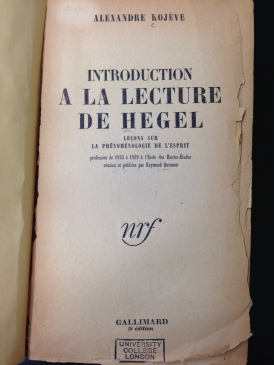
I fell in love with the idea of contradiction when I stumbled upon Alexandre Kojéve’s Introduction to the Reading of Hegel at the University College London Library on a cold autumn afternoon. The material sensations of holding the book have preserved this moment in my memory: the lovingly-made hard cover with its fabric coming out; the dusty smell that starts with the passing of the page and settles down slowly until you pass it again; the remnants of the many hands that have gone through these pages, underlining some passages without giving any thought to what future readers will think of it. I can feel the contents of the book grabbing me from the inside, moving me towards a debate around the notion of contradiction and the possibility of change.

Embracing contradiction may be the only avenue for progressive climate change action. This is the central argument that I present in the paper ‘Contradiction, intervention and the low carbon transition’, recently published in Environment and Planning D: Society and Space. The ideas in this paper emerged from a sense of frustration with current debates about the governance of climate change. I had long observed that ‘contradiction’ was frequently invoked in discussions of climate change governance, but rarely defined. I was sitting at a meeting discussing urban sustainability transitions, when a colleague referred to ‘contradiction’ to explain away the paradoxical nature of climate change governance in certain exemplary European city. This upset me. Like in other occasions, invoking contradiction was a means to end the discussion, rather than to open it up. Reviewing the literature on climate change governance, I struggled to find a coherent means to make sense of what contradictions were and why they mattered.

Until I found, pretty much by chance, Kojéve’s book on Hegel. I read it first out of a sense of curiosity, mostly because there is a part of me which yearns to open dusty covers of books. However, once I read this book, I found myself drawn into its ideas in a manner that I never felt before, not even reading Hegel’s own Phenomenology of the Spirit. Kojéve established a bridge between Hegel’s and my own thinking, and in doing so, it revolutionized everything I ever held sacred about contradictions and the possibility of progressive action in the context of global environmental governance.

Continue reading here.

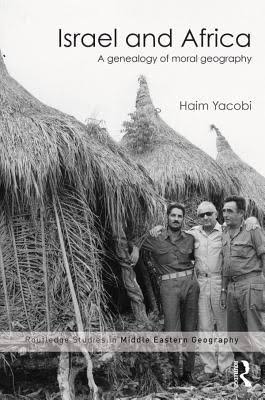
Two reviews of Haim Yacobi’s Israel and Africa: A Genealogy of Moral Geography

jacobiTwo reviews of Haim Yacobi’s Israel and Africa: A Genealogy of Moral Geography (Routledge, 2015) by Sherri Plonski and Kareem Rabie are now posted on the open site.

Society and Space lecture at the 2016 AAG by Prof Saba Mahmood

Screen Shot 2016-01-23 at 1.51.37 PMSaba Mahmood, Professor of Anthropology at University of California, Berkeley, will give the Society and Space lecture at the 2016 AAG meeting in San Francisco.

Her talk, titled “Secularism, Sovereignty, and Religious Difference: A Global Genealogy?”, will analyze secularism as a modality of sovereign power in the context of unequal geopolitical relations between the Western and non-Western world. Taking the Middle East as a point of departure, she will reflect on the central role religious difference plays in the making of political secularism.

The talk is scheduled for Thursday, 3/31/2016, from 10:00 AM – 11:40 AM in Imperial A, Hilton Hotel, Ballroom Level.

In Memoriam: Benedict Anderson (1936-2015) by Vicente L. Rafael

Benedict Anderson, Professor Emeritus of International Studies, Government and Asian Studies at Cornell University, and author, most famously, of Imagined Communities (1983) passed away in December, 2015. Here, Vicente Rafael offers some reflections in memoriam.


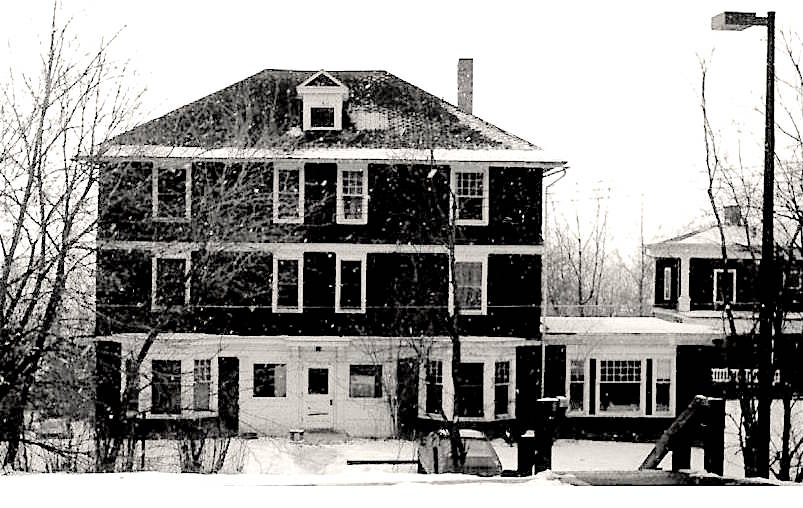
102 West AV, Cornell 1983

I first met Ben Anderson in 1979 when I began my graduate work at Cornell. He invited me to his home for dinner some 20 miles from Ithaca in a town improbably called Freeville—once the location of a juvenile detention facility called the George Junior Republic that had been the model for the Iwahig Penal Colony in the Philippines. Appropriately enough for Ben—a connoisseur of irony—his home used to be the warden’s who had to leave town hurriedly because of some scandal.

My office was directly above his in an old house that served as the site for the Modern Indonesia Project, more commonly known as 102 West Avenue by its denizens. It was a former fraternity house whose members had been kicked out of campus for some transgression, so we were essentially in frat row. The chairs and tables were scarred and stained with cigarette burns and coffee cups, the doors were cracked, the stairs creaked and the parts of the balustrade at times came off as you held on to them. Faculty, students and visiting professors worked in various offices, often late into the night, meeting during evening seminars and weekly brown bags featuring speakers ranging from diplomats to foreign scholars. In the summers, the frat boys sunbathed on the roofs, held beer balloon wars and played very loud rock and roll around us. The basement was full of boxes of file folders, which I always thought were Ben’s research notes, turning the place into a veritable firetrap. 102 West Ave., in short, was an ideal place to work. It’s ramshackle quality lent to it the feel of a refugee camp: precarious, resistant to domestication, but also ripe with insurgent possibilities. At 102, unexpected connections grew into friendships that led people into paths other than those they thought they had embarked on. Its informal atmosphere allowed for explorations of all sorts that deconstructed and deviated from the disciplinary formations that fixed and fixated many of us. Firmly but gently, Ben—sitting in his office, presiding over seminars, asking questions that always surprised and dis-oriented—served as the tutelary spirit of 102.

Continue reading here.

Tagged ,
Follow

Get every new post delivered to your Inbox.

Join 6,457 other followers