Judith Butler 2012 Parting Ways: Jewishness and the Critique of Zionism reviewed by Lisa Bhungalia
August 1, 2014 1 Comment
Lisa Bhungalia reviews Judith Butler’s 2012 book “Parting Ways: Jewishness and the Critique of Zionism”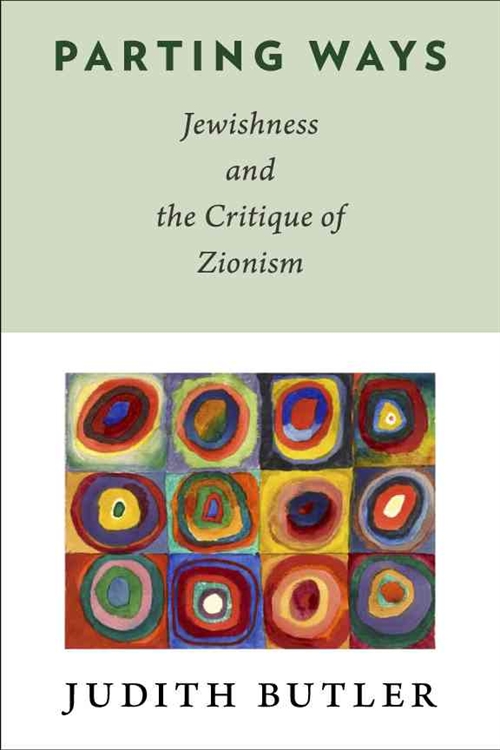
This is an updated version of the original posting.
It is day twenty-four of Israel’s latest military assault on Gaza. At the time of this posting, the Palestinian death toll exceeds 1,300 with casualties mounting by the hour. As per the most recent statistics from the United Nations, more than 250,000 residents have been internally displaced, many made refugees again, and much of Gaza’s urban and civilian infrastructure lay in ruins. To date, Israel has expropriated forty-four percent of this densely populated territory for a ‘buffer zone’, decimating neighborhoods within the demarcated area and forbidding Palestinians to return. As Israel’s ground invasion and aerial bombardments continue, the blockade imposed on this territory in 2006 remains in place (Rabbani 2014). Palestinians in Gaza are thus not only targeted by military violence, but they are further victimized by a regime of enforced immobility that has produced and maintained a humanitarian crisis for the 1.8 million inhabitants of this territory (Feldman 2014). Israel’s policy of forced enclosure (upheld along the southern border with Egypt) makes a mockery of the Israeli military’s ‘humanitarian warnings’ of impending attack. As even Jon Stewart has observed, ‘Evacuate to where? Have you seen Gaza?’
The scale and scope of destruction wrought on Gaza in the last twenty-four days, while devastating, is not exceptional. Rather it is, as Nimer Sultany (2014) notes, ‘once again’. It is ‘once again’ in multiple senses – first, and perhaps most commonly, the phrase is evoked in reference to the repetition of Palestinian death and destruction, as currently on brutal display in Gaza, as well as during previous Israeli incursions (2008-9, 2012). It is also used rhetorically to refer to an unceasing ‘cycle of violence’ between Israelis and Palestinians wherein wanton violence, it is argued, is inflicted on both sides (Shupak 2014). In this sense, ‘once again’ posits a false symmetry between Israel and the Palestinians while rendering outsiders passive, even if despaired, onlookers. However ‘once again’ is, as Sultany (2014) notes, not a ‘mere rhetorical gesture nor symptomatic of tragic despair.’ Rather it signals a ‘recursive power dynamic and a structural relationship between an occupier and an occupied.’
It is this context that is so often omitted from view in dominant coverage of the Israeli-Palestinian conflict. As evidenced in popular coverage of Israel’s latest military assault of Gaza, the narrative most often begins with an unprovoked act of violence carried out on the part of the Palestinian ‘side’ to which Israel responds – and the cycle repeats. We hear of rockets launched into Israel; we hear of Israeli soldiers captured and killed. The narrative is about Israel’s victimhood, restraint or triumphalism in the face of imminent threat. Meanwhile mass Palestinian displacement and death is lamented as the unfortunate result of the dismantlement of ‘terrorist infrastructure’, or equally troubling, attributed to a ‘culture of martyrdom’ in which Palestinians will sacrifice even their own. Palestinians are themselves to blame for their own death and suffering. We hear nothing of the fact that in the absence of rocket fire into Israel, the siege on Gaza remains, settlement expansion across the West Bank continues and Palestinians remain subjects under Israeli military rule. During times of ‘calm’, strategies of containment and dispossession continue unabated.
That Palestinians continue to live in a political and ideological context in which they are deemed a demographic problem to be contained and controlled, in which their lives are taken with impunity, and in which they are disenfranchised, divided and placed under siege is rarely foregrounded in analyses of this ‘conflict.’ We are instead given sensational and easily digestible tropes of violence on ‘both sides’, ‘war’, and unrelenting ‘age-old religious conflict.’ In the absence of context, a false symmetry emerges – Israel and Hamas, it is commonly said are ‘at war’ (and if not Hamas, then any other number of Islamic and Palestinian ‘threats’ and ‘spoilers’ to peace). Such a framing however erases the multiple qualitative and quantitative differences at play between Israel and the Palestinians – yet even more crucially, it masks a political project predicated on the privileging of Jewish life, and correspondingly, devaluation of the life of the non-Jewish other. It is this context that has inspired Judith Butler’s most recent book, Parting Ways: Jewishness and the Critique of Zionism.
Continue reading Lisa’s review here
Look out for an interview from Palestine with Lisa Bhungalia by Society and Space editorial team, Mat Coleman, Mary Thomas and Kathryn Yusoff next week.
Readers might also be interested in Christopher Harker’s review “Five Broken Geographies” of Emad Burnat’s film “5 Broken Cameras” on Society and Space Open Site and Gerry Kearns review of Judith Butler’s geopolitics, “The Butler affair and the geopolitics of identity” in Environment and Planning D: Society and Space (paywall).


Rupal Oza – India’s relations with Israel and Palestine: Tracing a tectonic shift
September 18, 2014 by natalieoswin 2 Comments
Rupal Oza’s 2007 Society and Space article, Contrapuntal geographies of threat and security: the United States, India, and Israel, is currently open access as part of a virtual issue on Israel-Palestine. In it, she describes how India echoed US discursive constructions of Muslim males as dangerous after the attacks of September 11, 2001, and examines how this demarcation of ‘us against them’ created new political alliances between India, the United States and Israel. In her new commentary below, Oza expands and updates her analysis of India’s shifting relations with Israel and Palestine, and thus provides a critical take on India’s response to the recent devastation of Gaza.
-The Editors
As the Israeli attack on Gaza intensified in July 2014, a large poster made an appearance in front of some hotels in Mumbai that depicted icons of prominent U.S. products and read, “Indian Hoteliers boycott Israeli and U.S. products.” Boycott has a long history and political resonance in India dating back to anti-colonial struggles from the early 20th century and also from the anti-apartheid movement when India boycotted South Africa. This most recent boycott, however, does not have the same tenor or carry the same moral or ethical weight.
Nor is India’s recent vote in support of a United Nations resolution to launch a probe into Israel’s offensive into Gaza indicative of a shift in official policy towards Israel. India’s vote at the UN needs to be read in the context of the BRICS summit that had just occurred in Fortaleza, Brazil and was Prime Minister Narendra Modi’s first big external summit. The Fortaleza Declaration signed by all the BRICS countries held them to the goals and principles in the declaration, including one that dealt with Arab-Israeli peace and that committed the BRICS countries to sign the UN resolution. It was this international political position rather than an ethical or moral position that led to India’s UN vote. Indeed on August 16th 2014 the Prime Minister’s party, the BJP, organized a pro-Israeli rally in the former left stronghold of Kolkata that brought out twenty thousand people in support.
There has been a tectonic shift in India’s relationship with Palestine and Israel in the last 25 years.
Continue reading here.
Filed under Commentaries Tagged with foreign policy, geopolitics, India, Israel, Palestine