
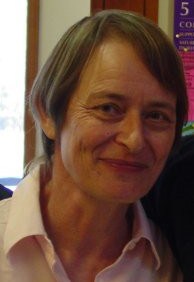
 Ontogenesis and the Ethics of Becoming: an interview with Elizabeth Grosz by Kathryn Yusoff
Elizabeth Grosz is a feminist philosopher and Professor of Women’s Studies at Duke University. Her work has been important for geographers because of its engagements with spatial practices, volatile and sexed bodies, and the arts of cosmic engagement. More recently, audiences have been turning to Grosz’ work because of its explicit engagement with the inhuman forces of the earth and the explication of the forms of “geopower“. In this interview Grosz discusses her new book about questions of ontology and ethics, which draws on the philosophies of the Stoics, Spinoza, Nietzsche to address materialist idealism.
Elizabeth Grosz: I am currently working on a book, sort of on ethics, but more directly about questions of ontology. The book will include a chapter each on the Stoics, Spinoza, Nietzsche (who I can’t seem to stop writing about), Deleuze, Gilbert Simondon and Raymond Ruyer. It doesn’t have a title yet but I am nearing the end, slowly. What I am interested in is thinking about ethics, not in terms of morality, a code of conduct or a set of principles to regulate conduct from the outside, but in terms of the exploration of becoming, what kind of a new ontology – an ontogenesis – we must develop in order to understanding the becomings that underlie and make being possible. Each chapter addresses a philosopher, or a group of philosophers (in the case of the Stoics) who articulates a world-view, an analysis of what is or can be, in which the question of the limits, mortality, and smallness of the human relative to the vast and powerful laws of the universe is the primary focus. Moreover, each of these philosophers, while appearing to be materialists, and addressing questions about the world through materialism, remain attached to a concept of the ideal, ideality, or conceptuality that is irreducible to anything material. Each can be considered, in the limited terms of any binarisation of mind and body, as an paradoxical idealist materialist or materialist idealist. In other words, each articulates what a pure materialism is unable to explain; each remains committed to the activity of ideas and their direct impact on and transformation of matter through their energetic and informational flows into forms of knowledge as well, without understanding or reducing ideas to simply bodily or neurological movements. Each thus established the non-material reality of ideas, the way in which the universe generates orders, orientations, directions or sense as it elaborates its own complexities. Taken together, these thinkers establish a kind of genealogy of thinking about informed matter and the relations to life forms that depend on it and extend it each in their own ways. Continue reading this interview here

Reblogged this on Progressive Geographies and commented:
Kathryn Yusoff interviews Elizabeth Grosz on the Society and Space open site.
[…] interview on Society and Space with Elizabeth Grosz. Philosopher and feminist she has explored many sides of the forces that have […]